Quick Response Garage Doors repairs the doors businesses depend on in Renton: loading doors in the valley, roll-ups on storage buildings, and sectional doors on shops and service bays. A door that won't open or won't lock is treated as urgent, and the estimate is free.
Tell us what the door is doing. The estimate is free either way.
A house door might open a few times a day. A door on a warehouse, a shop or a service bay can open dozens of times before lunch, and every part wears in proportion: springs run through their cycles, cables fray at the drums, rollers flatten and operators run hot. Commercial repair starts from that difference.
The work covers sectional overhead doors, rolling steel doors and the lighter roll-up sheet doors common on storage buildings, along with the operators that drive them and the safety devices that stop them.
A door that won't open holds up a day's deliveries; one that won't close leaves the building exposed. Either way, the work happens in this order.
Sectional overhead doors, the steel panels on track you see on service bays and shops, fail the way house doors do, only faster: springs, cables, rollers and hinges, plus sections bent by a backing truck.
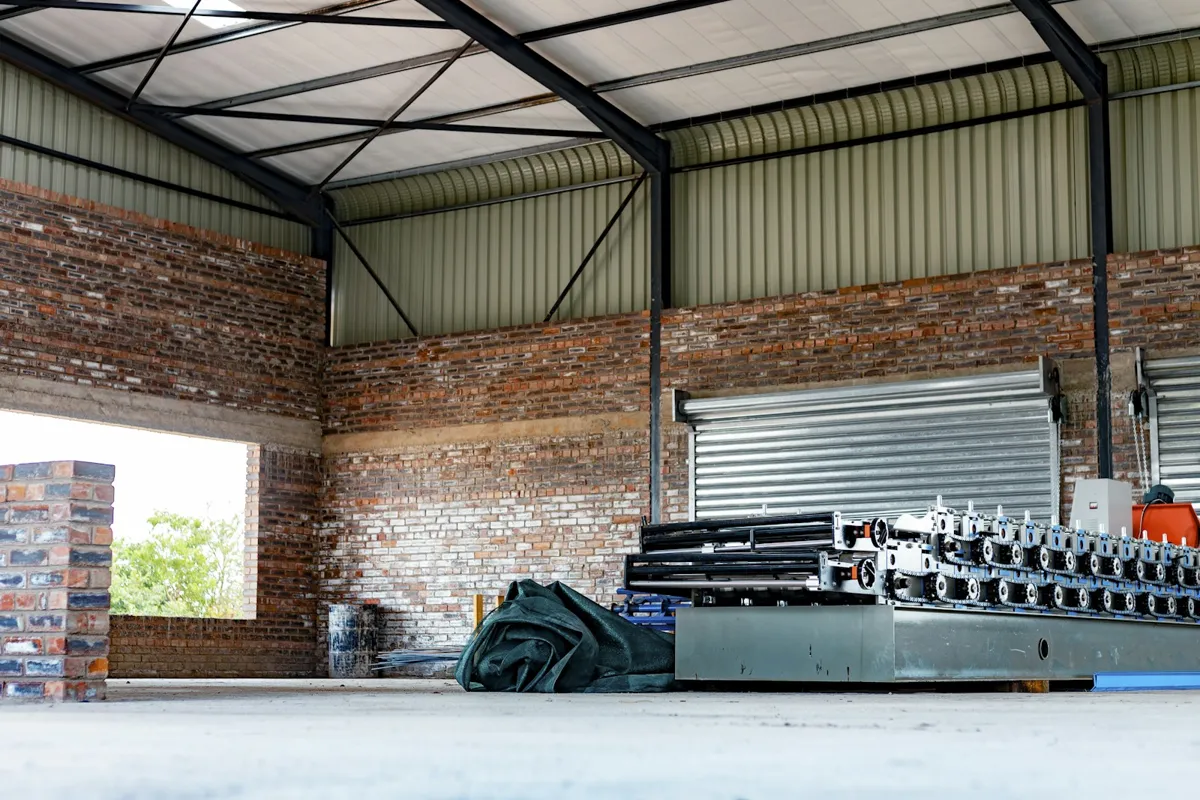
Rolling steel doors coil around a barrel above the opening, with springs inside the barrel and the curtain riding in side guides. Their calls are tired springs, slats knocked out of line, guides bent inward and bottom bars that no longer meet the lock.
Roll-up sheet doors on storage buildings and metal shops are lighter and simpler. They mostly need their drum tension set, straps and latches renewed, or a dented curtain straightened or swapped.
Security grilles, the see-through rolling kind on storefronts and service counters, run on the same barrel, springs and guides as a rolling steel door and are repaired the same way.
Commercial springs can be ordered for a much higher cycle count than standard ones, and on a busy door they last noticeably longer between replacements. When one spring breaks, the others on the door have seen the same number of cycles, so the estimate shows whether replacing the whole set makes sense.
Cables and drums get the same attention, since a cable that frays under a heavy door can drop one side of it without warning. Spring work on a commercial door is not something for staff to attempt; the stored tension is far greater than on a house door.
Commercial operators come in a few types: trolley units that pull the door along a rail, jackshaft units that turn the spring shaft from the side, and hoist units with a hand chain for when the power is out. Many run from a three-button station, open, close and stop, and that station is often the first thing daily use wears out.
An operator that's decades old and no longer supported for parts is usually better replaced than nursed along, and a new one is matched to the door's size, weight and how often it runs.
Safety devices, the photo eyes across the opening and the sensing edge along the bottom of the door, are tried on every visit. A door with a disabled edge is the one that comes down on a forklift or a person, so edges and eyes are repaired rather than bypassed.
Most commercial door damage is an impact: a truck backing in a little too far, a forklift mast still raised, a pallet caught on the way through. One bent section can jam the whole door, and a guide knocked inward pinches a rolling curtain until the operator trips out.
Damaged sections are replaced to match where they're still made, tracks and guides straightened or replaced, and the door rebalanced afterward. If the same opening keeps getting hit, bollards or frame guards are worth considering, and the estimate notes it.
Water runs toward plenty of loading areas on the valley floor, and the bottom of a commercial door spends much of the year wet. Bottom seals split, astragals tear, and the lowest track sections and guides rust long before the rest. Worn seals let rain and leaves into the building and make the operator work harder against a sticking door.
Seals, astragals and the lower hardware are renewed in coated or galvanized parts, and a threshold or a better seal profile can turn the runoff where a slab slopes toward the opening.
Buildings with a row of doors often have several that are tired at once. They can all be looked at on the same visit, with one estimate that lists each door separately so you can decide which to fix now and which can wait.
Doors still raised by hand can be converted to motor operation, and older operators can be swapped for units sized to the door. Work is planned around opening hours so the building keeps running. Fleet yards that need drivers to open bays can have remotes or keyed switches set up at the same time.
Yes. Springs, slats, guides, bottom bars and operators on rolling steel doors, as well as sectional overhead doors and roll-up sheet doors.
Securing the building comes first. The door is closed and made safe, and if a part has to be ordered, the full repair is scheduled after that.
Usually. Bent sections are replaced, tracks or guides are straightened or replaced, and the door is rebalanced. A whole new door is needed only when the damage is widespread.
In most cases, yes. The door is balanced first, since an operator needs a door that moves freely, and then an operator is sized to it.
Yes. Repairs that can wait are booked for a time that keeps the building running, and several doors can be handled in one visit.
Yes. Drum tension, straps, latches, guides and dented curtains on roll-up sheet doors, one unit or a whole row.
On a door that opens many times a day, usually yes: they're built for far more cycles than standard springs, so they go much longer between replacements. On a door used a few times a week, standard springs are fine.
Yes. Every door on the visit is listed on a written free estimate before any work starts.
Tell us the fault and you'll get a straight answer on whether it can wait. Free estimate anywhere in King County.
Prefer to talk it through? Call (425) 696-1678.
Tell us what the door is doing. The estimate is free either way.