A bottom section bent by a bumper or a panel split by a basketball doesn't always mean a whole new door. Quick Response Garage Doors replaces damaged garage door sections around Renton when the door's maker still builds that section, and says so plainly when it doesn't. The estimate is free.
Tell us what the door is doing. The estimate is free either way.
A sectional garage door is a stack of four or five horizontal sections, joined by hinges and carried on rollers that ride in the track. Damage tends to stay where it landed. The bottom section takes the bumpers and the runoff, a middle section takes the ladder that slid or the ball that missed, and the sections above and below carry on as if nothing happened.
Because each section is a separate piece, the damaged one can be unbolted and a new one hung in its place while the rest of the door stays put. That is often far less disruption than a full replacement, and the door looks the way it did the week before the accident.
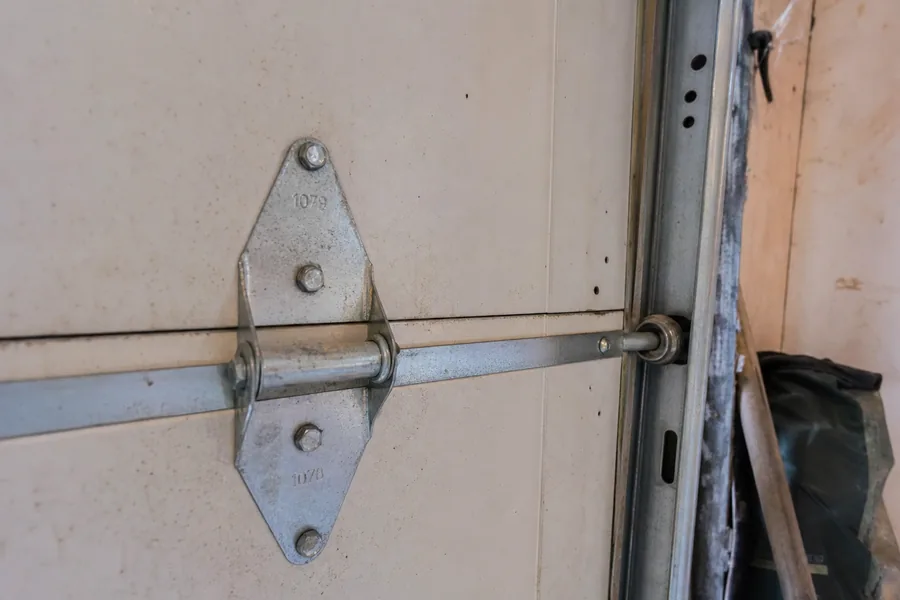
The condition is that the new section has to be the same design, height, thickness and panel pattern from the same maker. So the first job at the visit is identifying the door from its labels, its section profile and the stamping on its hardware.
On a tuck-under garage at the foot of a steep driveway, water heads straight for the door. It pools at the threshold all winter, soaks the bottom seal, and starts on the bottom section from the edge that sits on the slab. Steel sections rust from that bottom edge upward, often from the inside where nobody looks. Wood sections swell, split along the rails and soften until a screwdriver sinks in.
When the bottom section goes, the aluminum retainer that holds the seal usually goes with it, and the bottom brackets that anchor the lift cables are often rusted as well. Those are replaced together, because a new section sitting on a corroded bracket is a repair that comes back. Where the driveway sends water at the door, a threshold seal on the slab is worth talking about at the same visit.
Doors stay in production for a limited run, and an older door may no longer have a matching section available anywhere. Two or three damaged sections can add up to most of a door. A section swap on a door that is already rusting through elsewhere just moves the problem along the track.
In those cases you hear both options side by side: what one section would mean, and what a new door would mean, with the reasons for each. The decision stays yours, and nothing is ordered until you agree to it.
Factory colors are made to match when they're new. After years of rain and the odd sunny summer, an older door has usually faded a shade or two, and a fresh section can stand out in bright light even though it's the same color on paper. Embossed wood-grain patterns differ between product lines too, so the pattern is matched along with the color.
If the difference would bother you, painting the whole door after the new section is in is one way to bring it together. That gets discussed before anything is ordered, so there are no surprises when the new section goes up.
Wide two-car doors carry steel struts across some sections to keep them from bowing, and the top section usually has one where the opener arm attaches. A replacement section gets its strut moved over or a new one fastened on, so the door stays straight under the opener's pull.
Window sections are their own case. A cracked or fogged window insert can often be replaced without the section around it, depending on how the glass is held in. Insulated doors need an insulated replacement of the same build, foam board glued to one skin or foam injected between two, so the section matches its neighbors in weight, warmth and stiffness.
A replacement section is ordered to fit, so there are usually two visits: one to identify the door and one to hang the section.
A shallow dent in the middle of a panel is mostly cosmetic. If the door runs straight, closes evenly and seals at the bottom, it can often be left alone, and you'll be told so rather than sold a section.
A crease that runs across a section is different. It weakens the section where it flexes as the door turns the curve of the track, and the opener pushes on that weak spot every time the door closes. Damage near the hinges, at the edges or along the top rail affects how the section rides, and that is worth fixing before the door starts to bind.
Often, yes, when the maker still builds that section in the same size and design. The door is identified at the visit, and you hear whether a matching section can be ordered before anything else happens.
The design and pattern will. The color may read a shade different on a door that has spent years in the weather, and you hear about that, along with the option of painting the whole door, before ordering.
Usually it means the bottom section, its seal retainer and the bottom brackets. If rust has reached the track or other sections, the estimate covers that too, so nothing is left half done.
A door is balanced by its springs, and a new section rarely weighs exactly what the old one did. The tension is set to the door as it now stands, so it lifts lightly and stays put halfway.
Not always. Many window inserts can be replaced on their own; it depends on how the glass is held in that section.
When the design is no longer made, when several sections are damaged, or when the rest of the door is near the end of its life. Both options are laid out with the reasons.
Yes. The door is looked at, you hear what it needs and whether a section can be had, and the free estimate comes before any work.
Tell us the fault and you'll get a straight answer on whether it can wait. Free estimate anywhere in King County.
Prefer to talk it through? Call (425) 696-1678.
Tell us what the door is doing. The estimate is free either way.